
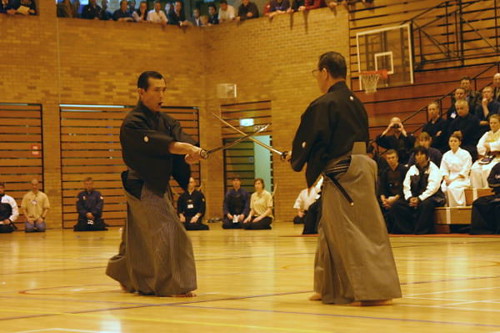
by Paul Budden
Sumi-ryu: The essence of Sumi-ryu is Kata-geiko – as a training method is understanding the cause and effect of each movement. Differs from grading Kata.
The following are key aspects in the study and practise of Kata:
Riai ‘Format’ – how it works – Method. Also not to try the impossible in a fight with your partner, but to move and respond to opportunities, using Ideal logical movement According to the Principles of Nature.
Relationship: Uchidachi ‘the one who leads’ – Shidachi ‘the one who follows.’ The principle of Aiki as in ‘Follow the movement and timing’ not to be confused with harmony, (Aikido) as in ‘Wa’.
Uchidachi – Should have empathy and an understanding of Shidachi’s needs – light striking to encourage the application of good Waza – technique is essential and Shidachi should make effort to adhere to the concept of Aiki – ‘follow the movement and timing’. The relationship of Motodachi and Kakarite have the similar elements of Uchidachi and Shidachi.
Distance (Maai) – Use ‘The mechanism’ to judge distance i.e. 5 and 3 step footwork.
Breathing – Use Ki-ken-tai – coordination of body, sword and Kiai for efficiency in breath use.
Zanshin: Total awareness – must be maintained throughout with emphasis in the final instance after the Waza is completed.
Body movement – 70% lower body 30% upper body and sword. Ensure correct foot positions are maintained in line with standard Kendo stances.
Namba Aruki – Was the running and walking style famously used by the express runners (hikyaku 飛脚) during Japan’s Edo Period (1603–1868).
Aligns with the body’s natural biomechanics, enhancing balance, stamina, and efficiency. It reduces wasted motion, keeps posture stable, coordinates power between the limbs and hips, and allows movement to remain smooth and controlled without unnecessary strain. Maintains the connection between the upper and lower body. Particularly important in all three Kodachi forms, ensuring smooth, controlled advancement and engagement.
Footwork – Control toe raising in Suri-ashi and Ayumi-ashi. Use Chidori-gake in Yonhonme to maintain Hamni and slow the approach in order to observe.
Use Chidori-gake in the Kodachi forms to maintain Hamni and move forward quickly.
Kamae – Make natural transition when changing Kamae i.e. don’t assume different arm positions such as elbows sticking out.
Application timing differences – In the Kata when changing Kamae – Sanbonme, Yonhonme, Ropponme and in the three Kodachi kata.
Understanding the Bokutō/sword – Designated areas of: Attack, Control and Defence on the blade.
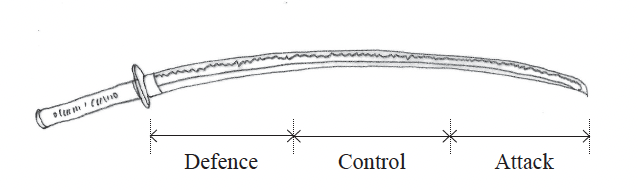
Designated areas of sword
While the translation of Satsu is ‘to kill ‘, we prefer to use ‘Attack’ to emphasise the practical use of the Monouchi when using the Odachi and Kodachi.
Use of Kodachi – small sword – holding is the same as with the long sword.
Don’t be overly powerful when using. The strength of the Kodachi is in the body movement – Timing and ‘Irimi’ to enter.
A Different interpretation of footwork is also required.
Shu: Look and learn
Ha: Absorb and analyse
Ri: Natural application – expression and feeling
(Also relative in Shinai kendo)
Copyright © 2025 Paul Budden