
by Paul Budden
“Shiai is the forge, and Enbu is the flame that reveals the steel.”
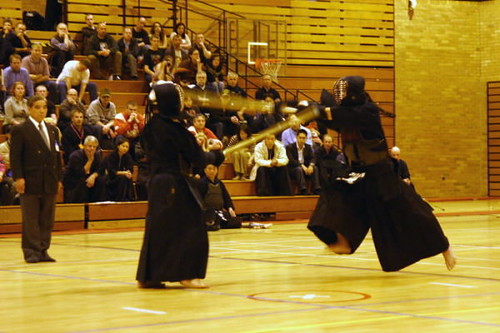
Competition has always played an important role in the development of Kendo, particularly for younger practitioners. It offers a clear framework in which skill, timing, and spirit can be tested. For those in the early stages of their training, shiai provides both motivation and direction — a tangible goal that focuses effort and encourages perseverance. The contest is not merely about winning or losing, but about confronting fear, managing pressure, and discovering how one’s technique functions in the living moment.
Through shiai, young practitioners learn decisiveness, self-control, and respect. They come to understand that success is earned through constant effort, and that genuine progress arises not from triumph, but from reflection upon failure. In this sense, competition serves as an essential educational tool. It drives engagement, strengthens community, and inspires the next generation to continue refining themselves and their art.
As a practitioner’s experience deepens, the purpose of training must also evolve. For senior exponents, the unending pursuit of medals or rank risks obscuring the true nature of Kendo as a Way (Do) — a lifelong study of character, balance, and inner composure.
The spirit of shiai can too easily become entangled with ego and external validation, diverting attention from the essence of practise: the cultivation of sincerity (makoto) and correct mind (seishin).
At this stage, enbu — formal demonstration — assumes greater importance. In enbu, there is no opponent to defeat and no audience to impress. There is only the expression of understanding through refined movement, correct spirit, and harmonious timing. The focus shifts from competition to communication — the sharing of insight rather than the proving of strength.
In enbu, the swordsman’s heart becomes visible. Every cut, every pause, every bow reflects years of discipline distilled into a single moment of clarity. It demands a different kind of courage — not the explosive spirit of combat, but the quiet resolve of one who stands before others and reveals their art without concealment.
It is a mirror of one’s true level, unshaped by the pressure of points or judges. For senior practitioners, therefore, enbu represents the natural evolution of shiai. The lessons learned in youth through contest — endurance, humility, and composure — find their mature expression in the poise and dignity of demonstration. In this way, shiai and enbu form two halves of a complete path: one for building the body and spirit, the other for expressing wisdom and grace.
To sustain the future of Kendo, both must coexist. The enthusiasm of youth is nourished by the challenge of competition, but it also requires the steady example of those who embody the deeper spirit of the art. Senior practitioners have a duty to guide by presence as much as by instruction — to remind others, through their conduct, that Kendo is not merely a sport, but a lifelong study of human character.
In the end, the measure of success in Kendo is not found in medals or trophies, but in the refinement of the self. As we progress, we learn that shiai is the forge, and enbu is the flame that reveals the steel. Together, they ensure that Kendo remains both a living tradition and a true Way — rooted in competition when necessary, but always returning to sincerity, respect, and the quiet pursuit of perfection.
Copyright © 2025 Paul Budden