
By Paul Budden
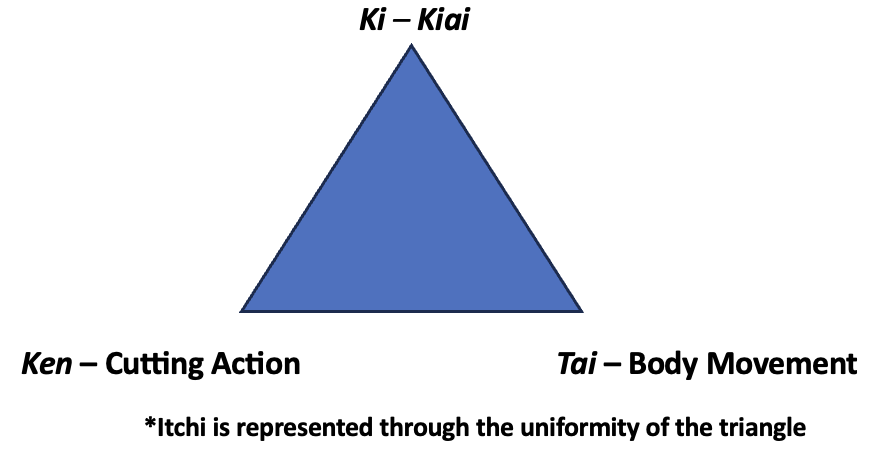
I’d like to offer a personal interpretation on the concept of Ki-Ken-Tai-Itchi which is all about ‘balance.’
A principle that will shape every strike you make from now on.
Even as beginners, we can understand this clearly and start applying it right away.
Think of this as learning to coordinate your whole self. When your spirit, your sword (shinai or bokuto), and your body move together, your technique becomes smooth, strong, and natural.
Ki – Your Spirit and Your Voice is your intention – Your mental focus – Your Kiai is how you express it.
- Your Kiai shows that you’re committed to the strike.
- It helps you breathe correctly and stay relaxed.
- It connects your mind to your movement.
You don’t need to shout as loud as possible. What matters is that your Kiai is honest. A quiet but focused Kiai is better than a loud one with no meaning behind it – balance is the key.
When your spirit is clear, your body follows.
Ken – Your Cutting Action – The strike – When you swing the shinai or bokuto:
- Keep your hands relaxed, not tight.
- Let the sword move smoothly but sharply, not forced.
- Aim for a clean, straight path.
- Think of “cutting through,” not “hitting at.”
There is often an overuse in arm strength. Coupled with an imbalance of a too straight right arm and weak left arm. Real sharpness comes from good form and again from balance using both arms equally, not relying solely on muscle power.
A clean sharp cutting action tells us your intention is clear. A messy strike tells us your mind and body aren’t working together yet.
Tai – Your Body Movement and the required balance
A simple way to remember the balance is:
- 30% upper body
- 70% lower body
Your upper body guides the cutting action. Your lower body – Your legs, hips, and centre – gives you power and stability when moving when using both Suri- ashi and Fumikomi footwork.
For beginners, the most common issues are:
- Feet moving too late
- Hips not engaged
- Upper body leaning forward
- Shoulders tensing up
When your lower body leads the movement, everything becomes easier. When your upper body tries to do all the work, everything becomes harder.
Itchi – Everything Together
- Your Kiai
- Your cutting action
- Your body movement
All happen at the same moment, this the meaning of Ki-Ken-Tai-Itchi
Not one after the other. Not almost together. Exactly together.
When they line up:
- Your strike feels sharp and smooth
- Your timing improves
- Your balance becomes stable
- Your power increases without extra effort
When they don’t line up, the strike feels awkward or weak and that’s completely normal at first. Coordination takes time.
Conclusion:
You don’t need to be perfect. You just need to be aware.
If your Kiai is strong but your footwork is late – Notice it. If your cut is clean but your body is stiff – Notice it. If everything feels disconnected – Notice it.
Overall, it’s understanding that an equal balance of the three elements of Ki-Ken-Tai-Itchi is essential.
Awareness is the first step toward improvement.
Your goal is to polish each part, little by little, until they naturally come together as one.
When Ki, Ken, and Tai unite and are balanced, even a beginner’s strike becomes confident and powerful.
Through Kata-geiko we can further refine the concept of Ki-Ken-Tai-Itchi for tsuki and oji waza.
Copyright © 2026 Paul Budden