
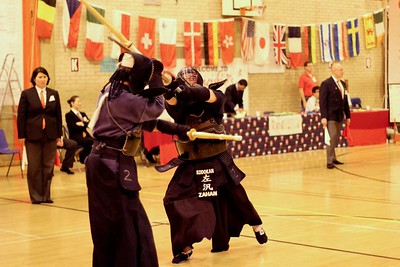
by Paul Budden
So what of the future direction of international kendo? John Bowen, former member of the GB Judo team, mentioned to me that there are moves in British judo towards making it even more of a sport than a life-forming discipline. This transition took seed after judo became Olympic in 1964. We can also see how the sportification of kendo has altered the fundamentals of a once martial discipline – bugei, Knutsen sensei in his book ‘The Line of Beauty’ states that:
“All sport demands, to succeed and become popular, on organisation and regulations; the result, on one side, is often fracturing through rivalries; on the other, it is chaotic. Sport cries out for administrators, often hordes of them, and many of these ‘officials’ lack the real experience that will smother creativity and the application of inner understanding. I won’t elaborate only to suggest that complex rules are not applicable to the bugei. Secret levels, arcane traditions; these things never come under artificial controlling rules and ‘sport’ totally opposite to the true martial arts.”
Following a discussion with my old friend Ian Parker–Dodd on this subject, he pointed out that we cannot ignore the positive changes wrought by Kanō in the move from jujutsu to judo, i.e., from practical fighting to education for living. The transformation of kenjutsu into kendo followed a similar route from practical fighting to education, but Ian added:
“There is a sporting aspect in both educational kendo and judo, but I think the fact that the sporting aspect has come to predominate is the problem and it’s a more general late 20th-century phenomenon – for example, Aerobics was designed as an activity for all, but commercial pressures turned it into a sport. So, turning things into competitive sports has given the Olympics (IOC) a power that I think is not always for the good of humankind.”
This affirms Roald Knutsen’s comment on the issue of ‘inexperienced officials.’ However, we should also consider that this may not just be by an individual’s actions but collectively by misguided organisational committees with ill-thought-out ‘agendas’ outside the membership’s best interest and the future of the sport or activity.
Ian then also offered the following synopsis:
“Sports activities have criteria for winning and losing. These criteria indicate what controls a sport as well as offering a way to see which theoretical disciplines could offer insight. Kendo, however, is claimed to be more than a sport. It’s a budo, of which kendo is a part and is a way of self-development that requires the practitioners to see beyond mere technical skill and challenges them to be self-disciplined, courteous and socially responsible. These challenges, whilst present in some sports, are central to kendo. They are outside the classification for sporting criteria. Epilogue However, I do find it useful to classify kendo as a sport because some of its attributes come within a definition of sport according to the following;
- It is essentially competitive; that is, a struggle for ascendancy takes place;
- The rules encapsulate an arbitrary problem; yuko-datotsu (a valid strike in kendo), has certain characteristics which are defined by the rules;
- A contract to compete requires certain things to happen and certain things not to happen.
Examination of these attributes shows that sports are essentially controlled activities.
As the purpose of a kendo shiai (a competitive match) is to strike your opponent success fully twice without them doing it to you, coincidence/anticipation is eagerly sorted by the kendo exponent in this situation; this is an example of item (i) in the above criteria.”
After considering these points, could the fate of competitive judo still await kendo should it become an Olympic sport one day? Membership of the IOC indeed would only be instigated as a last attempt to halt a dramatic decrease in the kendo population numbers in Japan. Could there be any other reason for such a monumental decision? Would this be a mistake? Could it be considered as a refinement in the best interest of kendo? Or a final farewell to a bygone era? Of course, originally as a bugei, kendo has consistently morphed for its continued survival since its inception all those centuries ago? A catalogue of events, including the introduction of kata using bokken – wooden swords alongside real swords for training drills. The development of protective body armour (bogu). The introduction of fukuro-shinai (leather-bound pieces of bamboo) followed by the bamboo shinai (practice foil). Sakakibara Kenkichi’s gekken-kai (public shows of swordsmanship) allowed kendo to survive the Meiji restoration. The change from gekken to kendo not just as terminology but in its application and introduction established kendo within the Japanese education system. The period of the False bushido. The martial arts ban after WWII and the formatting of shinai-kyogi (kendo practised like European fencing). The formation of the AJKF and the sportification of kendo transformed it into a World Championship Sport. The list is formidable. With the future yet to be written, I wonder if kendo, with all its proven ability to adapt to changing circumstances, can retain its essence, or will it be a bridge too far. There will need to be some kind of manifesto that lays out the unnegotiable elements of kendo so that if there were to be lost, it is clear where they were lost and what would be needed to retrieve them.
From The Legacy of the Budokwai ‘Epilogue’
Copyright © 2025 Paul Budden